
By: Ariana Siu

Photo Link– Picture from NASA- The total solar eclipse on Aug. 21, 2017, photographed from Oregon, the United States (Interrante).
On April 8, 2024, a total solar eclipse will begin its journey across the South Pacific Ocean. The solar eclipse’s path of totality will grace Canada, Mexico, and the United States, straying from North America via the coast of Newfoundland, Canada.
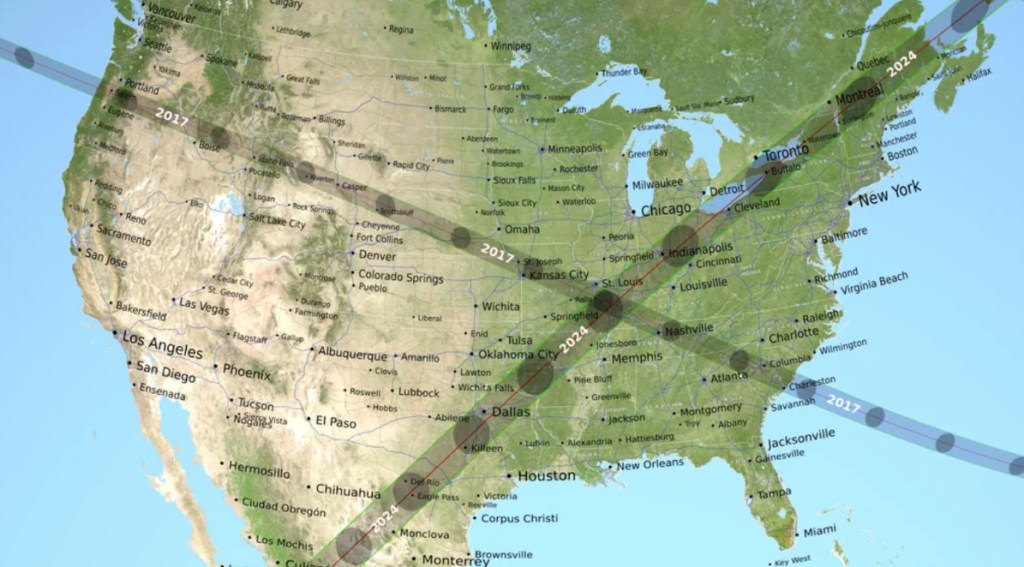
Photo Link– Picture from NASA- An estimated 31.6 million people live in the path of April’s solar eclipse (Interrante).
A total solar eclipse occurs when the moon travels directly between the Earth and the Sun, shadowing our planet and engulfing it in a blanket of shade. It is not an everyday occurrence that we get to admire the wonderful effects of the solar system. Total solar eclipses are a blend of luck and physics, as cities that reside directly under the Moon will be able to witness the event, while those situated at an angle would experience a partial solar eclipse because the Moon, the Sun, and the Earth do not perfectly line up.
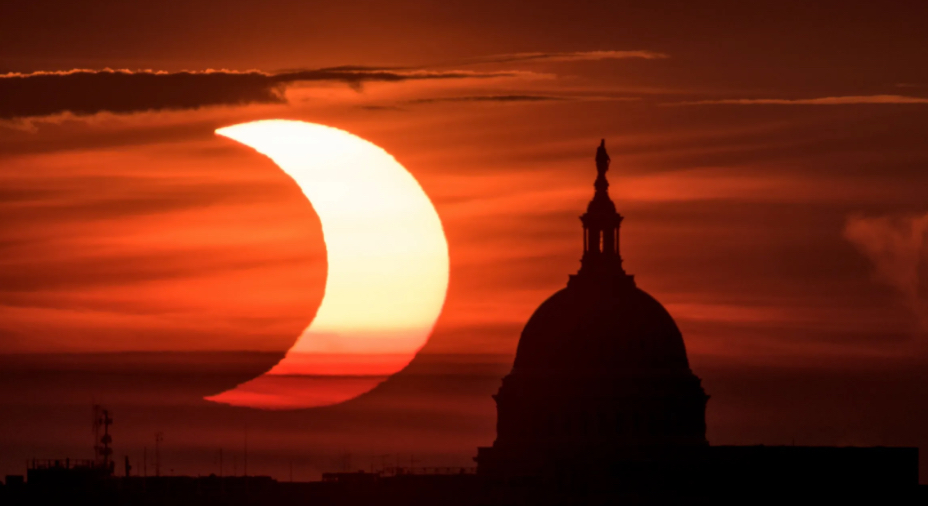
Photo Link– Picture from NASA- The partial solar eclipse visible from the United States Capitol building on June 10, 2021 at sunrise (“Eclipses”).
A total solar eclipse results in a breathtaking golden halo of light in the sky which is the Sun’s corona. Ever since the news of the upcoming solar eclipse, hotels at visible sites have recorded a spike in reservations for April, showing the great measures many would take to guarantee a view of the eclipse. It is no surprise that many space enthusiasts travel long distances to witness such a rare natural phenomenon. The next time humanity will be able to witness a solar eclipse of the same kind across the United States will not be until August of 2044, thus this April is certainly not an opportunity to miss out on.
If you would like to view the eclipse, remember to do so with precaution! Learn more about eye protection and what to expect at: https://science.nasa.gov/eclipses/future-eclipses/eclipse-2024/safety/
Works Cited
“Eclipses.” NASA Science, https://science.nasa.gov/eclipses/. Accessed 6 March 2024.
Interrante, Abbey. “How the 2024 Total Solar Eclipse Is Different than the 2017 Eclipse.” NASA Science, 30 January 2024, https://science.nasa.gov/solar-system/skywatching/how-is-the-2024-total-solar-eclipse-different-than-the-2017-eclipse/. Accessed 6 March 2024.
“2024 Total Eclipse: Where & When.” NASA Science, 4 March 2024, https://science.nasa.gov/eclipses/future-eclipses/eclipse-2024/where-when/. Accessed 6 March 2024.
 Titan Times