
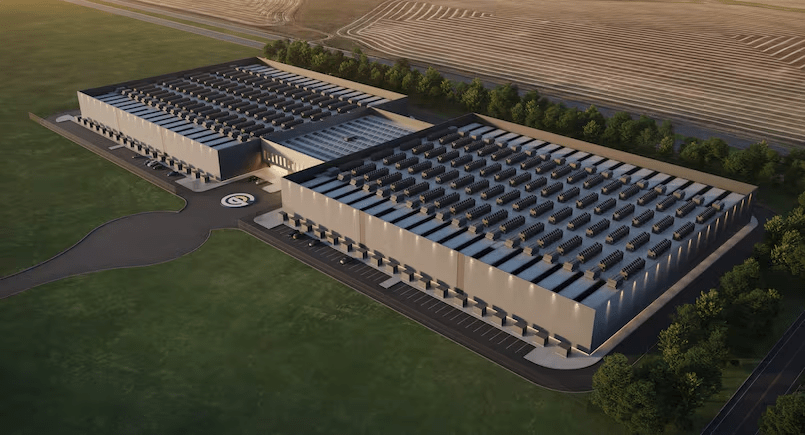
Render of Cal-3
Written By Petra Tsakopoulos
With an increasing demand for generative AI, companies like eStruxure, based in Montreal, seek to operate in Alberta because of its cool climate and accessibility to power. The company currently operates CAL-2, the largest data centre in Northern Calgary’s Rocky View County. This is a 93,000 square foot facility that has 26 megawatts of power capacity, which is enough to provide electricity for 26,000 homes.
Currently, the company is building CAL-3, a new facility that is expected to begin operations in 2026. This centre will have a data capacity three times that of a typical 90-megawatt centre. It will host AI servers that do more work, generate more heat, and will require liquid cooling systems such as piping filled with glycol solution and air cooling to prevent an excessive usage of water.
Data centres are criticized by the people of Alberta for their excessive usage of water, a scarce resource, to cool servers and prevent them from overheating. According to this U.S.-based study, mid-sized data centres consume 1 million litres of water per day, which is the average daily consumption of 1,000 homes. Consequently, companies like eStruxture use natural gases from their facilities, since they emit less carbon than other high-emitting gases, to achieve sustainability. CAL-2 uses cooling equipment that pulls in the cold Alberta air during the winter.
Noman Bashie, a computing and climate associate professor at the Massachusetts Institute of Technology, argues that the industry’s drive to find different cooling systems will impose a trade-off known as the Jevons paradox, by which new efficient solutions for power generation will drive the increasing demand for AI rather than prevent it.
With a limited supply of water and geographic space left for power generation, host cities like Calgary must identify a solution that will support the growing demand for generative AI, while preventing the increase in energy generation pushed by sustainable practices. While both are important to maintain, the province’s climate faces a major dilemma.
Works Cited
Ali, Rukhsar. “Alberta Wants to Become an AI Data Centre Hub, but This Rural County Just Rejected a Big Proposal.” CBC, 12 Sept. 2025, http://www.cbc.ca/news/canada/calgary/rocky-view-county-data-centre-proposal-1.7630860.
“Do AI Data Centres Have a PR Problem? A Look inside a “Sustainable” High-Tech Facility.” CBC, 2 Dec. 2025, http://www.cbc.ca/news/canada/calgary/data-centre-public-perception-alberta-9.699640. Accessed 5 Dec. 2025.
Yañez-Barnuevo, Miguel. “Data Centers and Water Consumption | Article | EESI.” Eesi.org, 25 June 2025, http://www.eesi.org/articles/view/data-centers-and-water-consumption.
 Titan Times