
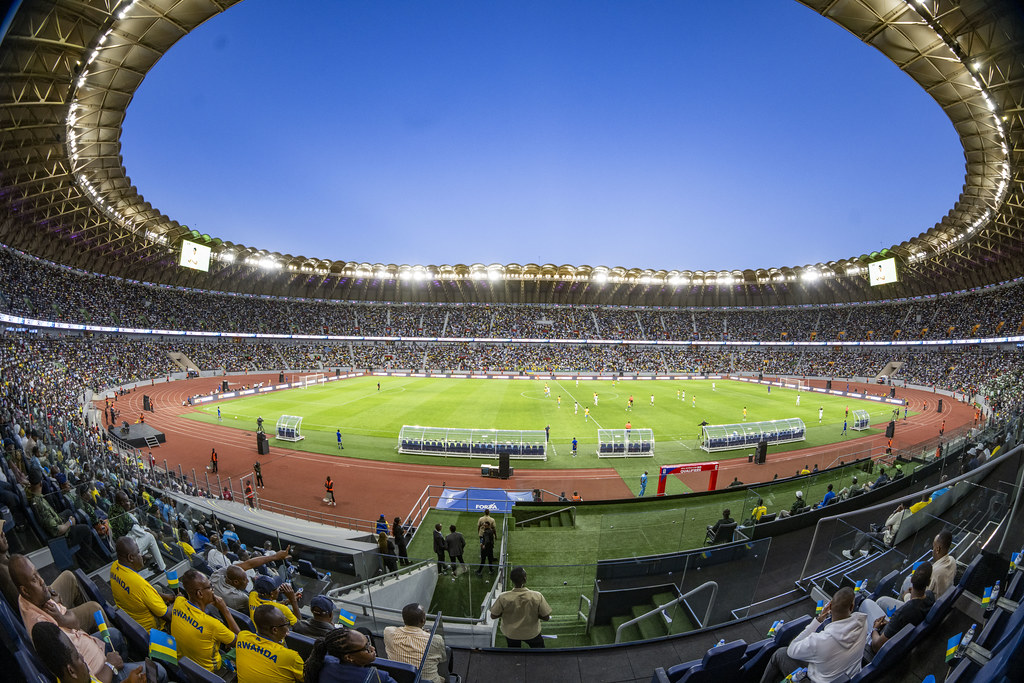
A look at the qualifiers of the 2026 FIFA World Cup. Photo by Paul Kagame, CC BY-NC-ND 2.0 on Flickr
By Martin Zhen
The “Beautiful Game” is coming to Toronto! The 2026 FIFA World Cup is taking place in less than a year, with six matches being held right here in Toronto. The 2026 FIFA World Cup will be the first World Cup hosted by three nations: USA, Canada, and Mexico. Instead of the traditional 32-team format, next year’s world cup will feature 48 teams, meaning more goals, action, and fun. As of November 12, 28 of the 48 teams participating in the 2026 FIFA World Cup have qualified. In the 2022 FIFA World Cup, audience engagement reached over 5 billion people, and that number is expected to further increase with the introduction of the 48-team format, allowing more teams to play and more viewers watching (FIFA).
So what does this mean for Toronto? From a financial perspective, the 2026 World Cup will be extremely beneficial for Toronto’s economy. An Economic Impact Assessment conducted by Deloitte Canada shows that from June 2023 to August 2026, preparing for and hosting the World Cup 2026 will contribute up to $3.6B in economic output, with $940M in the Greater Toronto Area alone. Not only will Toronto receive this huge economic boost, but the Assessment also forecasts the creation and preservation of over 6,600 jobs within the window of June 2023 to August 2026, temporarily relieving Toronto’s job crisis. In addition, Toronto is projected to have a GDP growth of $520 million (Bollenbach).
However, Toronto still has a lot of work to do before hosting the 2026 FIFA World Cup. The City of Toronto recently finished phase 1 of their upgrades at BMO Field, whose condition is not yet World Cup-worthy. The recent work the City of Toronto completed includes the installation of 4 new videoboards, improvements in the concession and concourse areas with self-serve technology, upgraded Wi-Fi, as well as new lounge and suite renovations. The next phase of the BMO field renovations consists of a temporary seating expansion to 45,000 seats, an increase of 17,000, as well as LED stadium lighting to meet FIFA regulations, new dugouts, and infrastructure refinements. In fact, over $123 million from the City of Toronto has been put into this renovation of BMO field.
With the 2026 World Cup creeping closer and closer, more and more people are scrambling over tickets at BMO field for the FIFA World Cup (City of Toronto). Unlike the 2022 FIFA World Cup, where anyone could buy tickets, this world cup’s ticketing comes in a lottery-style draw. There is first an application process, then a randomized draw, and only then can one buy their tickets. There are three draws taking place for this world cup, being the Visa Presale Draw, Early Ticket Draw, and Random Selection Draw, with the Visa Presale and Early Ticket Draw already passed (FIFA). However, there is still hope for those who did not make the first two draws. Even if one misses the Random Selection Draw phase, they will still have the chance to buy tickets through the Last-Minute Sales Phase, or through resellers. On the other hand, in a region with 6.7 million people, tickets are not going to be that cheap or easy to obtain. In team Canada’s opening group stage match in Toronto on June 12, tickets are reaching a base price in the thousands, with better tickets ranging in the tens of thousands of dollars (StubHub). This proves to be extremely lucrative for ticket resellers, as people who get a ticket draw are able to buy tickets on the cheap and sell them on the high, raking in massive profits.
With the 2026 FIFA World Cup coming closer and closer, more preparations are being made as everyone prepares for the arrival of football to Toronto. While many may see this as a burden on Toronto or a tedious task, the statistics say otherwise. Assessments predict huge economic boosts to both Canada and Toronto, and high levels of tourism, bringing more cheer to Toronto and revitalizing our city. With the introduction of randomized draws in this world cup, obtaining tickets has become way harder. Combined with a population of 6.7 million, ticket prices are soaring through the sky, which is why most people opt to get lucky in a draw and buy through FIFA. So, who’s ready to get lucky and win some tickets?
Works Cited
City of Toronto. “City of Toronto and MLSE Complete Phase 1 Upgrades at Toronto Stadium Ahead of FIFA World Cup 26TM.” City of Toronto, 23 Sept. 2025, http://www.toronto.ca/news/city-of-toronto-and-mlse-complete-phase-1-upgrades-at-toronto-stadium-ahead-of-fifa-world-cup-26/.
“Football World Cup Tickets.” Stubhub.Ca, http://www.stubhub.ca/soccer-world-cup-toronto-tickets-6-12-2026/event/153021783/?quantity=2&priceOption=1,1465,1617635.47. Accessed 24 Oct. 2025.
Graham, Bryan Armen. “A World Cup Preying on Fomo: Fifa’s 2026 Ticket Scheme Is a Late-Capitalist Hellscape.” The Guardian, The Guardian, 11 Oct. 2025, http://www.theguardian.com/football/2025/oct/11/fifa-2026-world-cup-tickets-dynamic-pricing-nft-resale.
“Inside FIFA.” Fifa.com, inside.fifa.com/tournament-organisation/audience-reports/qatar-2022. Accessed 24 Oct. 2025.
Kagame, Paul. “2026 FIFA World Cup qualifier game between Rwanda’s Amavubi and
Nigeria’s Super Eagles | Kigali, 21 March 2025.” Flickr, 21 Mar. 2025, https://www.flickr.com/photos/paulkagame/54400387127/
“Qualified teams for the FIFA World Cup 26.” Fifa.com, http://www.fifa.com/en/tournaments/mens/worldcup/canadamexicousa2026/articles/world-cup-2026-who-has-qualified. Accessed 4 Nov. 2025.
“REPORT FOR ACTION FIFA World Cup 2026 Toronto: Economic Benefits of Hosting, Soccer for All Legacy Fund, and Community Benefits Plan Updates.” Toronto.Ca, 2025, http://www.toronto.ca/legdocs/mmis/2025/fwc/bgrd/backgroundfile-253733.pdf.
Fifa.com, gpcustomersupportfwc2026.tickets.fifa.com/hc/en-gb/articles/30519468735133-1-How-will-I-have-the-chance-to-purchase-ticket-s-for-the-FIFA-World-Cup-26. Accessed 24 Oct. 2025.
 Titan Times