
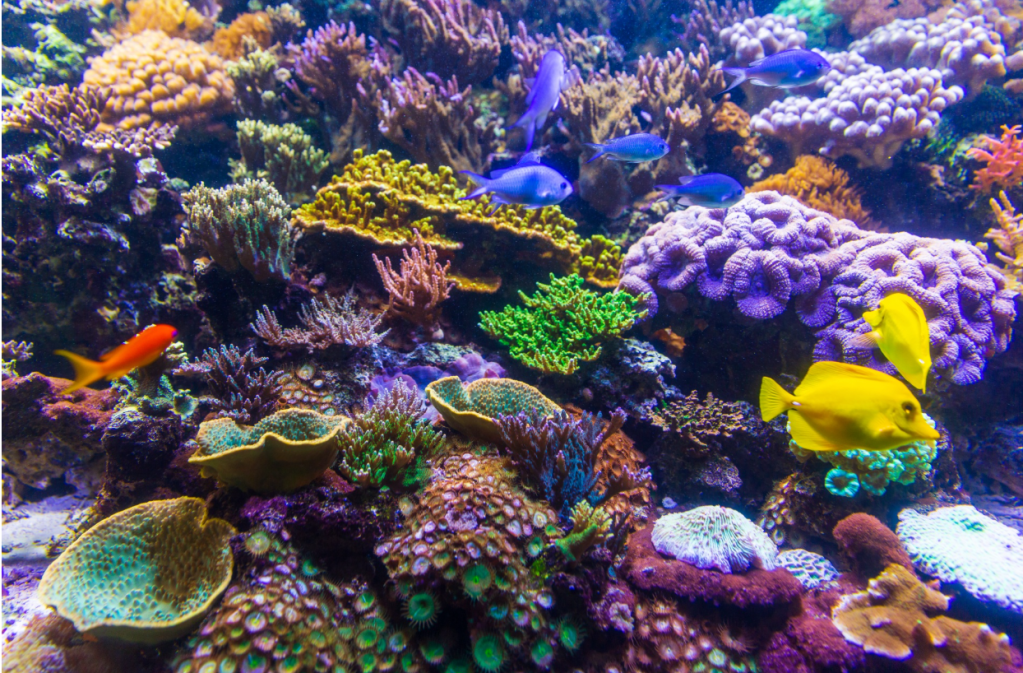
CC0 1.0 Universal
https://www.publicdomainpictures.net/en/view-image.php?image=314254&picture=coral-reef
Written By: Jessica Chui
On land, trees and lush greenery populate the terrain. But what of those in the deep oceans? Those that we may not see every day, yet hold significance in the marine ecosystem? They are coral reefs. Often referred to as the “rainforests of the sea”, coral reefs support a wide range of marine species by offering habitats and protection against storms. This article will cover some of the most beautiful coral reefs on Earth, changes that coral reefs are experiencing, and the actions the scientific community are taking.
Part of the Seven Natural Wonders of the World, we have the beautiful Great Barrier Reef. The reef is just off Australia’s northeastern coast, and spans roughly the size of Italy. This area is so large that it is visible from space! The Great Barrier Reef is composed of over three thousand individual reef systems and is made up of over six hundred species of coral. For more than 60,000 years, the Indigenous and Torres Strait Islander peoples have lived on, cared for, and passed down stories of this sea Country. Today, there are still ongoing spiritual and cultural connections to the reef, which highlight its remarkable importance to both humans and ecosystems (Britannica). Closely behind the Great Barrier Reef is the Belize Barrier Reef, which is a UNESCO World Heritage Site. The Belize Barrier Reef is the largest barrier reef in the Northern Hemisphere, containing more than a hundred hard and soft coral species, along with five hundred species of fish. Moreover, it is a major source of seafood, especially lobster and conch, and attracts tourists from all over the world to sightsee here (Britannica).
However, coral reefs globally are experiencing changes—harmful ones—that threaten their growth. With the growing problem of global warming, coral reefs are polluted by the increasing acidity levels of oceans. This is a huge chemical transformation in the marine environment: as more carbon dioxide dissolves into the ocean, its acidity level increases, leading to ocean acidification. This poses a large-scale threat to countless marine species that rely on reefs for safety and survival (Marine Biodiversity & Sustainability Learning Center). In addition, problems like industrial pollution and overfishing also add to the list of dangers that the ocean faces.
To address this, the scientific community has taken action through research on coral farming and replanting methods. According to the National Oceanic and Atmospheric Administration (NOAA), conservationists learned to nurture small pieces of coral on underwater structures, which are then replanted on existing reefs when they are strong enough However, the fastest-growing hard corals take a year to grow only ten centimeters, making recovery challenging. Fortunately, corals can grow much faster in low-stress environments such as nurseries, allowing the reefs a fighting chance. Moreover, the Coral Reef Conservation Program and NOAA Fisheries are engaged in research to better understand the challenges of coral reefs, as well as plan future actions. At present, these organizations have already invested in multiple projects for ocean restoration. For instance, they have begun growing and planting on established reefs in Puerto Rico and the US Virgin Islands, and are expecting to see acres of regeneration in just a few years (National Oceanic and Atmospheric Administration). With these efforts, it gives our society hope that these practices can help stimulate the recovery of marine ecosystems.
Though often unseen, coral reefs play a vital role in maintaining the health and balance of marine ecosystems. Protecting them should be a priority, so that future generations can experience and appreciate these natural beauties. As threats like climate change and industrial pollution continue to rise, collective action becomes more important than ever. With continued preservation efforts, there is still hope for the recovery of these incredible ecosystems.
Works Cited
Britannica. “Belize Barrier Reef | Map, Facts, Location, & Climate.” Britannica, 30 June 2023, https://www.britannica.com/place/Belize-Barrier-Reef. Accessed 13 April 2026.
Great Barrier Reef Foundation. “The Great Barrier Reef explained: size, species, threats and why it matters.” Great Barrier Reef Foundation, 17 April 2025, https://www.barrierreef.org/news/news/the-great-barrier-reef-explained. Accessed 13 April 2026.
Maldives Magazine. “Coral Reefs of the Maldives.” Maldives Magazine, 2022, https://maldives-magazine.com/diving/corals-reefs.htm. Accessed 13 April 2026.
Marine Biodiversity & Sustainability Learning Center. “Ocean Acidification’s Ripple Effect: How Marine Life Changes Impacts Coastal Communities.” Marine Biodiversity & Sustainability Learning Center, 13 February 2025, https://www.marinebiodiversity.ca/ocean-acidifications-ripple-effect-how-marine-life-changes-impact-coastal-communities/. Accessed 13 April 2026.
National Oceanic and Atmospheric Administration. “Hope for Corals: Growing Species Resilience in Coral Nurseries.” NOAA’s National Ocean Service, 2024, https://oceanservice.noaa.gov/ocean/corals/hope-for-corals.html. Accessed 26 April 2026.
Public Domain Pictures. “Coral Reef Free Stock Photo.” Public Domain Pictures, https://www.publicdomainpictures.net/en/view-image.php?image=314254&picture=coral-reef. Accessed 27 April 2026.

