
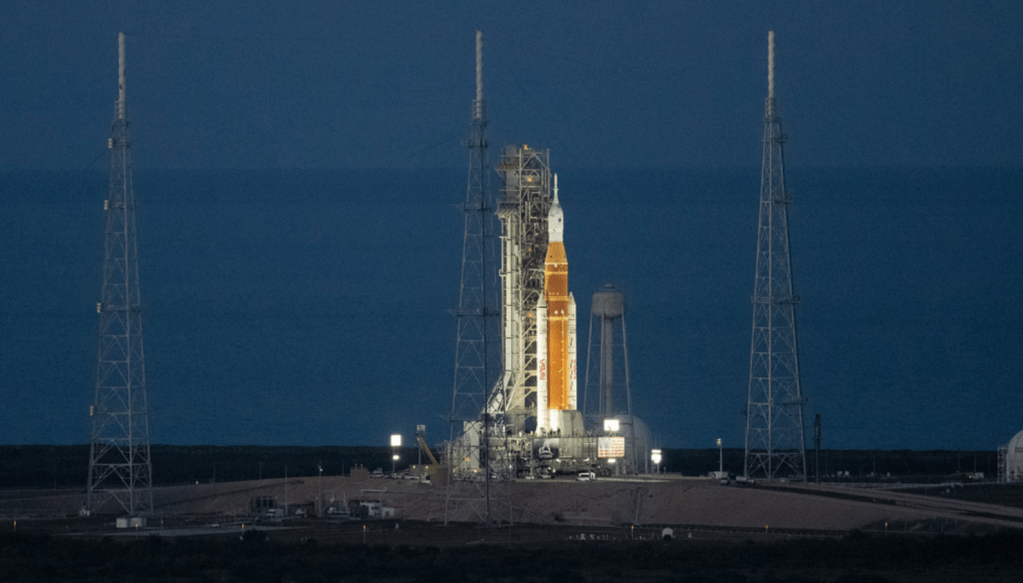
Artemis II Rollout by Joel Kowsky
CC BY-NC-ND 4.0
https://www.flickr.com/photos/nasahqphoto/55047365507
Written By: Jessica Chui
Recently, the media has been buzzing all about NASA’s Artemis II mission, a historic event taking place nearly 50 years after the legendary Apollo missions. Seen by many as a modern-day sequel, Artemis II marks the next giant leap in space science for humanity, as NASA carries astronauts farther than ever ventured before. This article will cover all the must-knows about the Artemis missions, focusing primarily on Artemis II, including its crew, launch dates, current goals, future plans, and a comparison to its predecessor, Apollo 8.
According to Greek mythology, Artemis is the goddess of hunting, wild nature, and chastity. She is the daughter of Zeus and the twin sister of Apollo (Cartwright). With Artemis as the name of the upcoming space mission, it personifies NASA’s return to the moon with a new wave of science and technology. So, what’s the plan? The Artemis missions will land astronauts on the moon and use innovative technology to explore more of the lunar surface. More importantly, these efforts aim to establish the first long-term human-robotic presence on and around the moon. You may be wondering: what is the main purpose of the Artemis missions then? NASA’s communication officer, Brian Dunbar, writes to the media that NASA is in the process of finding out more about the moon, and will then use the information to send future exploration missions to Mars. This highlights how the Artemis missions are largely significant to mankind, with NASA attempting to learn more about the history of the Earth, Moon, and our solar system, all the while inspiring new generations and encouraging careers in STEM (Dunbar). Now, let us shift our focus to the long-awaited Artemis II mission. This project is the second scheduled flight of the NASA Artemis program, but the first to fly astronauts on the Space Launch System (SLS) rocket and the Orion spacecraft. NASA will send four astronauts around the moon, then back to Earth. This is a looping mission, meaning that they do not actually land on the moon. Although this mission may seem less ambitious, the true reason for this mission is to ensure that the rocket systems perform smoothly under real conditions.
A reflection of modern society, the crew of Artemis II shows a growth in inclusivity and empowerment of race and gender. The crew includes Victor Glover, Reid Wisman, Christina Koch and Jeremy Hansen. Victor Glover is the pilot of Artemis II, and will be the first Black astronaut to fly around the moon. However, this is not his first time as a pilot; he was a former pilot on SpaceX’s Crew 1 mission. The commander is Reid Wiseman, a US Navy Aviator, with this mission as his second spaceflight. Of course, mission specialists are equally as important. They are Christina Koch and Jeremy Hansen. Koch holds the record of the longest single spaceflight by a woman, and has been 328 days aboard the International Space Station. Meanwhile, Hansen is a Canadian Air Force fighter pilot, who is embarking on his first spaceflight in this mission (Tingley).
Although the mission missed its original launch in February of 2026 due to technical difficulties, there are currently five potential launch dates for Artemis II, with none earlier than March 2026: March 6-9 and March 11. If the mission does not make these dates, then the next available date would be April 1, April 3-6, and April 30. Many dates are planned because the launch heavily depends on the final testing of the SLS rocket, Orion spacecraft and associated ground systems. Exciting news for astronomy lovers is that the next planned mission, Artemis III, is expected to land on the surface of the moon in 2027, if everything goes according to plan (Tingley).
Let us look back at the Apollo 8 mission and compare it with the Artemis II. In 1968, the Apollo 8 was launched to the moon by the rocket Saturn V. Its spacecraft was the Apollo Command Module, which carried astronauts and instruments into space. On the other hand, planned for 2026, Artemis II will be launched by the SLS rocket and carried by the Orion Spacecraft. The goal of Apollo 8 was to prove that humans could reach the moon, while Artemis II’s purpose is to conduct a test for deep-space systems for future missions (New Space Economy).
In all, the Artemis II mission represents a powerful step forward in humanity’s continuation of deep-space exploration. Building on the knowledge gained from the Apollo missions, Artemis II will test the SLS and Orion Spacecraft while sending astronauts farther from earth than any crew has traveled in decades. There is no doubt that this mission will help pave the way for future astronomical projects, including the planned Artemis III, and the eventual exploration of Mars.
Works Cited
Cartwright, Mark. “Artemis.” World History Encyclopedia, 24 July 2019, https://www.worldhistory.org/artemis/. Accessed 18 February 2026.
Dunbar, Brian. “What is Artemis?” NASA, 25 July 2019, https://www.nasa.gov/general/what-is-artemis/. Accessed 18 February 2026.
Kowsky, Joel. “Artemis II Rollout.” Flickr, 2026, https://www.flickr.com/photos/nasahqphoto/55047365507. Accessed 9 March 2026.
New Space Economy. “Apollo 8 and Artemis II: A Comparative Analysis of Lunar Missions.” New Space Economy, 2026, https://newspaceeconomy.ca/2026/02/02/apollo-8-and-artemis-ii-a-comparative-analysis-of-lunar-missions/. Accessed 4 March 2026.Tingley, Brett, et al. “NASA’s Artemis 2 mission: Everything you need to know.” Space, 3 February 2026, https://www.space.com/artemis-2-humans-moon-orbit. Accessed 3 March 2026.

